

Gender Affirming Hormone Therapy in Singapore
Gender Affirming Hormone Therapy, or GAHT, is a medical treatment that involves taking hormones such as oestrogen or testosterone to induce physical changes that align with a person’s gender identity. It is a key part of medical transition for many transgender and non-binary individuals, and requires specialist guidance from an endocrinologist.
GAHT affects many parts of the body, so safe treatment relies on appropriate hormone doses and regular check-ups. Some individuals may also see mental health professionals for additional support, but the main part of medical transition is hormone care guided by an endocrinologist.
At LG Endocrinology, we provide evidence-based, affirming, and medically supervised GAHT tailored to your individual health needs. Dr Gani focuses on precise hormone management, transparent discussions about expected changes, and long-term safety. Whether you are starting GAHT for the first time or transferring your care, our clinic offers a private and respectful environment where you can access dedicated endocrine expertise at every stage of your transition.
What Is Gender Affirming Hormone Therapy (GAHT)?
Gender Affirming Hormone Therapy (GAHT) is hormone therapy for individuals who have been assessed to experience gender dysphoria. It involves the medically supervised use of hormones to help align an individual’s physical characteristics with their gender identity.
Feminising Hormone Therapy typically involves the use of oestrogen together with anti-androgen medications, while Masculinising Hormone Therapy uses testosterone to support the development of more masculine characteristics. GAHT supports both physical transition and overall emotional well-being, and is usually a long-term therapy that requires regular monitoring to ensure safety and effectiveness.
In Singapore, GAHT must be prescribed by licensed doctors who are trained in transgender healthcare. This form of care is offered only after appropriate clinical evaluation, and treatment plans are tailored to each person’s health needs, goals, and safety considerations.
Types of GAHT
There are two main types of GAHT: Feminising Hormone Therapy and Masculinising Hormone Therapy. They use different hormone regimens to support the development of gender affirming physical changes.
Each approach produces its own set of effects and follows a timeline carefully monitored by the administering doctor. The table below highlights the key differences between the two treatments.
| Aspect | Feminising Hormone Therapy | Masculinising Hormone Therapy |
|---|---|---|
Primary Hormone | Oestrogen | Testosterone |
Additional Medication | Anti-androgens to lower testosterone | None typically required for suppression |
Key Physical Changes | Breast development, softer skin, reduced muscle mass | Deeper voice, facial and body hair growth, increased muscle mass |
Reproductive Effects | Reduced testosterone production and fertility over time | Suppresses menstruation and may reduce fertility |
Changes to Fat Distribution | Shift towards a more typically feminine pattern | Shift towards a more typically masculine pattern |
Monitoring Needs | Regular checks of hormone levels, liver function, blood pressure, and clotting risk | Monitoring of hormone levels, cardiovascular risk factors and metabolic changes |
Who Can Undergo GAHT?
GAHT is intended for individuals who experience significant distress or discomfort due to the mismatch between their gender identity and their secondary sex characteristics. It is commonly sought by transgender and non-binary individuals who wish to feminise or masculinise their physical features in a way that aligns more closely with their gender identity.
To begin GAHT safely, several criteria generally apply:
- Clinical assessment: Most individuals will undergo an evaluation by an endocrinologist or mental health professional to confirm that hormone therapy is clinically appropriate, and a diagnosis related to gender dysphoria may be part of this assessment.
- Age and consent requirements: Individuals 21 and above may start independently, while those 18 to 20 usually require parental consent in private care.

What Is the Process of GAHT?
The process of starting Gender Affirming Hormone Therapy involves several steps to ensure treatment is safe, appropriate, and aligned with your transition goals. Each stage helps assess your health needs and supports long-term monitoring.
The first step is a detailed assessment to review your personal goals, transition plans, medical history, and family history. Bringing transition-related documents, such as psychiatrist memos, overseas evaluations, or private HRT prescriptions, can help support the evaluation.
You may be asked questions about gender dysphoria, and if you have not had a formal assessment, a referral to a psychiatrist may be recommended. Baseline blood tests are usually required to check sex hormone levels and assess liver and kidney function, helping to identify any pre-existing issues before therapy begins. Depending on your health profile, a bone density scan may also be advised, since GAHT can affect long-term bone health.
After completing the necessary evaluations and tests, hormone therapy is initiated using standard starting doses tailored to your health status and transition goals. These doses are adjusted gradually to maintain safety while supporting desired physical changes. Early follow-up appointments help monitor your initial response, address any side effects, and refine your dosing as needed.
Response to hormone therapy can be assessed clinically and, in some individuals, through specific blood tests. Clinical monitoring focuses on asking about and examining for potential complications or side effects of GAHT, such as acne, deep venous thrombosis, sleep apnoea, unwanted hair growth or hair loss.
Regular review also helps ensure that the current regimen remains aligned with the individual’s treatment goals and whether any adjustments are needed. Broader health monitoring may include:
- Routine blood pressure checks
- Support for smoking cessation
- Encouraging regular movement
- Strengthening community connection and emotional well-being
- Screening for cancers based on organs present
- Assessing bone health
Routine blood test monitoring may include:
- Lipid profile to identify changes that may contribute to cardiovascular risk
- Full blood count to check for raised serum haematocrit in individuals on testosterone therapy
- Electrolytes and kidney function
- Diabetes screening, as GAHT may influence body composition and insulin sensitivity
- Testosterone levels
- Estradiol levels
Over time, treatment plans may be adjusted to keep therapy safe, effective, and optimised for long-term use.
Note:
Private endocrinologists in Singapore require a psychiatrist’s memo before prescribing HRT. However, they can carry out all necessary blood tests during your visit.
What Is The Timeline of Expected Changes for GAHT?
GAHT produces gradual physical changes, and each person progresses at a slightly different pace. Some effects appear early, while others take several years to develop fully.
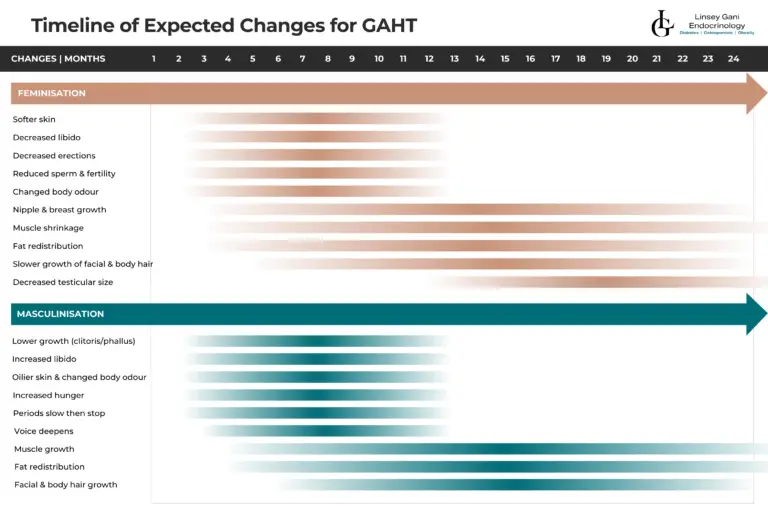
Early changes, such as softer skin and reduced libido, usually appear within 2 to 12 months. Breast development and fat redistribution tend to progress from 3 months, with ongoing changes continuing beyond the first year. Most feminising effects reach their full development over 2 to 3 years.
Voice deepening and changes in libido often begin within 2 to 12 months. Facial hair growth, muscle development, and fat redistribution typically progress starting from 6 months. Full masculinising changes can take 2 to 5 years, depending on individual factors and treatment consistency.
Our Trusted Endocrinologist
Dr Linsey Gani
Consultant Endocrinologist
MBBS (Aust), B Med Sci, FRACP (Endocrine), FAMS (S’pore), MPH (Harvard), Clinical Assistant Professor (Duke-NUS Medical School)
Languages: English, Mandarin, Bahasa Indonesia
Dr Gani is a skilled endocrinologist with experience guiding Gender Affirming Hormone Therapy. She is a fellow of the Royal Australian College of physician and the Academy of Medicine, Singapore.
Why Choose Us?

We understand that gender-affirming care is deeply personal. All consultations are conducted with complete discretion, respect, and sensitivity, creating a safe space for you to discuss your goals and concerns.

With extensive training in hormone-related health, Dr Gani brings specialised endocrinology knowledge to GAHT, offering a high level of clinical precision and safety throughout your transition.

We provide a holistic, evidence-based GAHT pathway that covers medical assessment, hormonal evaluation, safety screening, and long-term monitoring to ensure your transition is supported at every stage.
FAQs About GAHT
How often is follow-up needed for GAHT?
During the early phase of GAHT, reviews are usually scheduled every 3 months to monitor your response and adjust doses safely. As your hormone levels stabilise, appointments typically shift to every 6 months and eventually to an annual check.
Can you stop GAHT once you start?
Yes, you can choose to stop GAHT, but it is important to understand the implications. Some effects, such as changes in body fat distribution and the return of the menstrual cycle, may reverse over time. Others, including voice changes and facial hair growth, are considered permanent.
One key point to be aware of is that GAHT can affect fertility, and fertility may not fully return even after stopping treatment. As such, it is important to discuss family planning options before therapy begins.
Can you ever speed up the process of GAHT?
You cannot safely speed up GAHT. While your doctor may adjust your dose when clinically appropriate, hormones work best when increased gradually. Using excessively high doses does not make changes happen faster and can instead raise the risk of blood clots, heart disease, stroke, and certain cancers. The safest approach is to follow a supervised plan with dosing tailored to your health and monitored regularly.
Disclaimer
This information is provided for general education. It does not replace personalised medical advice. Please consult your doctor for guidance on the medications that may be appropriate for you.
Book an Appointment
Fill out the form below to schedule your appointment.
Dr. Linsey Gani Endocrinology
10 Sinaran Drive, #10-08, Novena Medical Center, Singapore 307506
+65 6397 7101
+65 9128 7480
Monday - Friday
08:30 - 12:30
Monday - Friday
14:00 - 17:30
Saturday
09:00-12:00
Sunday & Public Holiday
Closed
Monday - Friday
08:30 - 12:30
14:00 - 17:30
Saturday
09:00 - 12:00
Sunday & Public Holiday
Closed